 Rusk Component & Design
If you are comparing framing options for a new project, floor trusses are worth a closer look. While not every building needs them, they can make a lot of sense when you are trying to span farther, reduce beams and posts below, or create better space for plumbing, electrical, and ductwork. At Rusk Component & Design, our Strong Axis system is a good example of how modern floor trusses can be used to solve layout and coordination challenges more efficiently.
Why Some Projects Benefit More Than Others
One of the biggest reasons builders choose floor trusses is span. As spans increase, traditional weak-axis floor truss systems often need more material to keep up, including doubled or tripled chords, tighter web spacing, doubled webs, and larger connector plates. Rusk positions its Strong Axis floor truss as an alternate to that older standard, especially on projects where reducing the number of primary supports below is a priority.
That matters in real-world design because fewer beams and posts below can open up basements, garages, lower levels, and main-floor layouts. For designers, that means more freedom. For builders, it can mean fewer interruptions in the spaces below and a cleaner structural plan overall.
Projects where they often make sense include:
- Homes with longer, more open rooms
- Layouts where reducing beams and posts below is a priority
- Designs that need more flexibility in lower-level spaces
Performance Matters Too
Another time floor trusses make sense is when the feel of the finished floor matters just as much as the structural math. We specifically recommend 16-inch spacing with 3/4-inch plywood floor sheathing on its Strong Axis system because it creates a stiffer feel for the end user than greater spacing would. That is an important reminder that the best system is not always just the one that works on paper. It should also perform well once people are actually living or working on it.
This is where floor trusses can be especially valuable in custom homes, higher-end residential projects, and spaces where bounce or flexibility would be noticeable. A stronger, more carefully planned floor system can improve how the structure feels underfoot while also supporting the layout goals of the building. In other words, they can help bridge the gap between engineering requirements and everyday comfort.
Mechanical Space Is a Major Advantage
One of the clearest reasons to consider floor trusses is coordination with other trades. Ductwork, plumbing, and electrical runs all need room, and forcing them into a framing system after the fact can create headaches on site. Our Strong Axis floor truss is designed with this in mind. With a step-down condition and an 18-inch full depth, the system can include a minimum open chase area of 36 inches by 11 inches, and the web configuration can allow an 8-inch round duct to clear.
Rusk also notes that these can be spaced from 12 inches on center to 24 inches on center while still maintaining clear space between trusses for ducts, plumbing, electrical, and other runs parallel to the trusses. At 16 inches on center, for example, the clear distance between trusses is 14 1/2 inches. That kind of built-in coordination can reduce field changes and make life easier for multiple trades.
Some of the mechanical coordination benefits include:
- Dedicated chase space planned into the design
- Better room for ducts, plumbing, and electrical runs
- Fewer field modifications after framing is installed
A Practical Alternative To Standard Systems
At Rusk, we describe our Strong Axis floor truss as essentially a roof truss configuration for a floor. In step-down applications, it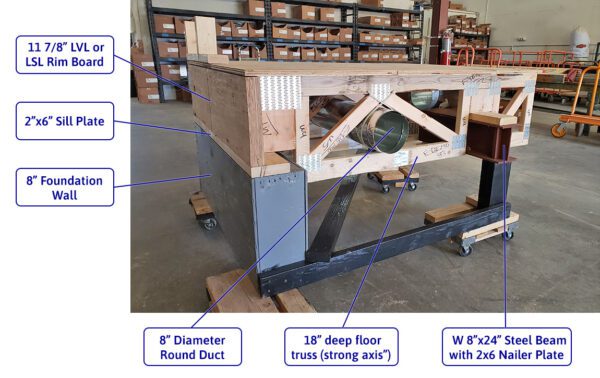 can reduce intrusion into the lower ceiling space and use an 11 7/8-inch deep LSL rim in place of a 2×4 flat ribbon. We also note that this rim detail can simplify exterior deck connections by allowing Simpson Strong-Tie SDW and SDS deck ledger details to be used in a manner similar to an I-joist floor system.
For projects with longer spans, more open space below, or tighter mechanical coordination needs, floor trusses can be a smart alternative to standard weak-axis floor trusses and some I-joist layouts. If you are weighing those options, Rusk Component & Design can help you look at the structure, the chase space, and the support conditions together so the system works for the whole project, not just one part of it.